
Account Structure
Funds may be held in an account in one of two models: a pooled (omnibus) account or individual demand deposit accounts (DDAs). Account numbers can be provisioned under either model, and the underlying account structure does not change how they operate. The difference that matters is who maintains the ledger of individual customer balances.Pooled Accounts
A pooled account, structured as a For Benefit Of (FBO) account, is a single account that Lead Bank holds, aggregating funds belonging to multiple end customers. You can still assign individual account numbers to each customer: the customer owns their assigned account numbers, and transactions initiated through them correspond to that customer’s funds. Lead maintains the ledger of the pooled account . You (or a third-party ledger provider) maintain the ledger of individual customer balances that collectively make up the pooled funds, and report it to Lead daily. Pooled accounts can provide significant scaling and pricing advantages compared to opening an individual DDA for each end customer.Your program agreement may require daily reconciliation between your ledger and the pooled account balance held at Lead. Your Technical Account Manager can confirm what applies to your program.
Demand Deposit Accounts (DDAs)
A demand deposit account (DDA) is an individual bank account opened in the name of the owner, allowing the customer to access funds on demand. Funds are not pooled with other customers, so no partner-supplied ledger data is required to represent ownership of funds.Relationship Between Account & Account Number Objects
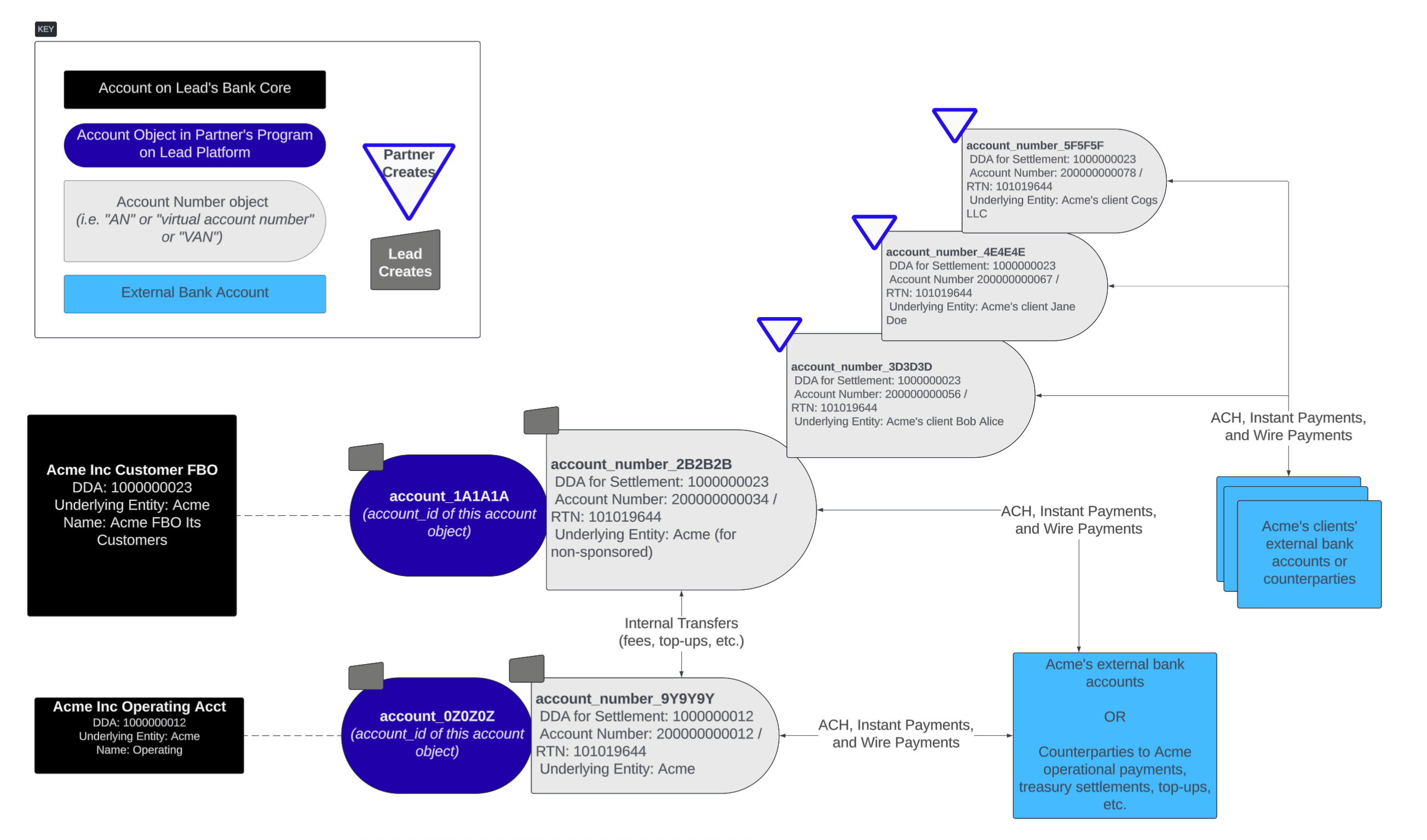
On Lead’s platform, account objects represent bank accounts in Lead’s platform. Each account object is identified by anaccount_id.
Example
The following example illustrates the relationship between Acme Inc’s FBO account, which hosts multiple account numbers associated with Acme Inc’s own customers, and its operating account. Theaccount_id here refers to the Account (core) concept.